RERA Act

 Maharashtra
 Karnataka
 Telangana
 Andhra Pradesh
 Delhi
Delhi
 Uttar Pradesh
 Haryana
 Gujarat
 Bihar
Bihar
- General
- Author: Riya Kapoor
Highlights
-
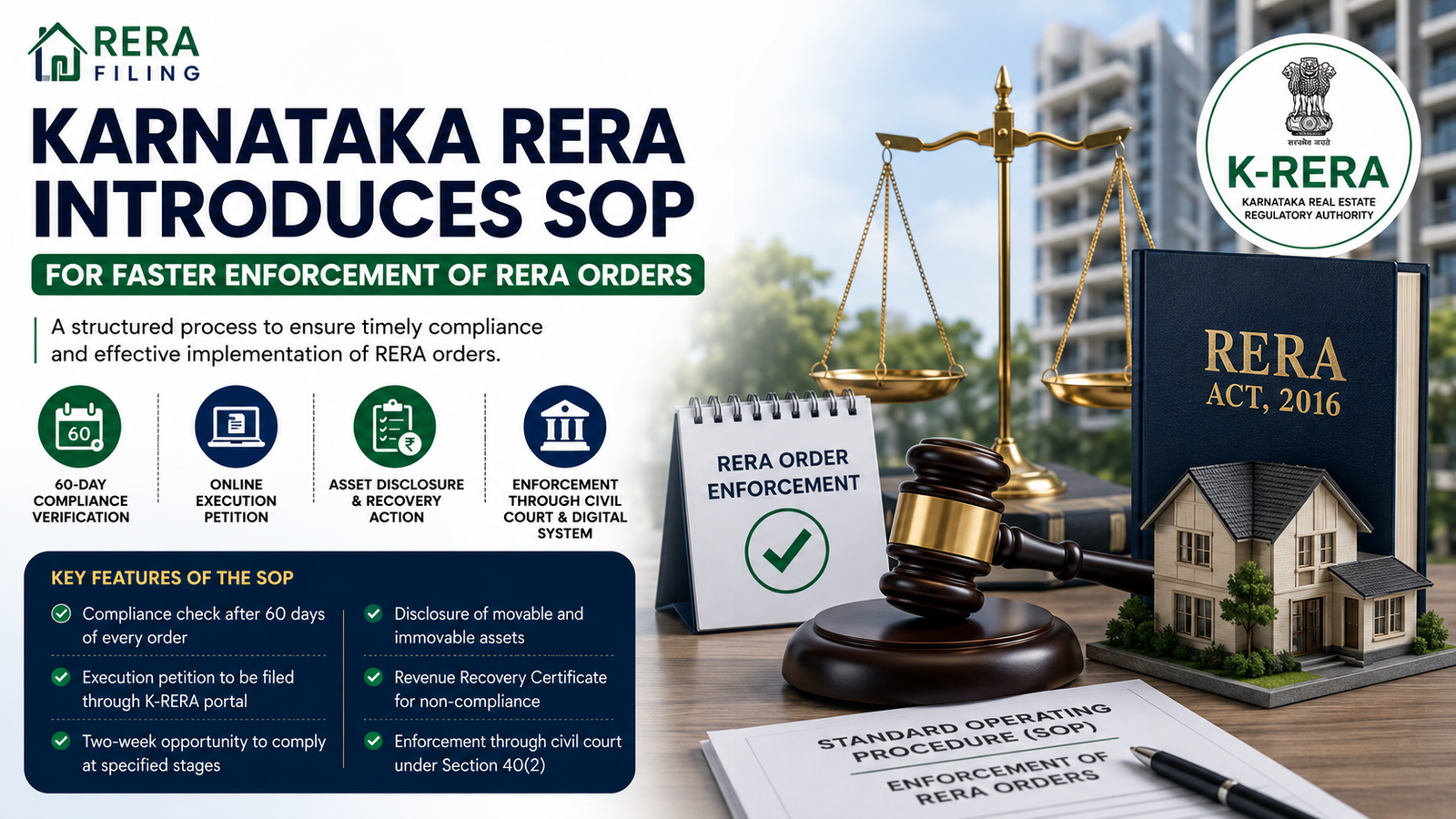
K-RERA Introduces SOP for Order Enforcement
-
60-Day Compliance Verification Made Mandatory
-
Online Execution Petition Process Launched
-
Asset Disclosure & Revenue Recovery for Non-Compliance
The Karnataka Real Estate Regulatory Authority (K-RERA) has
prescribed a Standard Operating Procedure (SOP) for the implementation,
execution and enforcement of orders passed by the Authority or the
Adjudicating Officer.
The SOP has been introduced in exercise of the powers
available under the Real Estate (Regulation and Development) Act, 2016, the
Karnataka RERA Rules, 2017 and the regulations of the Authority, and has come
into force with immediate effect.
The circular is particularly important for homebuyers,
promoters, real estate agents and other parties involved in RERA proceedings
because it lays down a structured process to be followed where an order passed
by Karnataka RERA is not complied with.
Legal Framework Under Section 40 of RERA
Section 40 of the RERA Act deals with the recovery of
interest, penalty and compensation as well as enforcement of orders passed
under the Act.
Under Section 40(1) read with Rule 25 of the
Karnataka RERA Rules, the Authority or the Adjudicating Officer, as the
case may be, can recover interest, penalty or compensation from a promoter,
allottee or real estate agent in the same manner as arrears of land revenue, in
accordance with the Karnataka Land Revenue Act, 1964 and the applicable rules.
Further, Section 40(2) read with Rule 26 enables
the Authority or Adjudicating Officer to enforce its orders or directions in
the same manner as if they were a decree or order passed by the principal civil
court of original jurisdiction.
60-Day Compliance Verification
Under the new SOP, after the expiry of 60 days from
the date of passing of an order, Karnataka RERA will verify whether the
order has been complied with.
For this purpose, the Authority will send a communication to
both parties seeking their response regarding compliance with the order.
This creates a defined mechanism for monitoring compliance
after an order has been passed.
Filing of Execution Petition
If the Judgment Debtor fails to fully comply with
the RERA order, the Decree Holder can proceed with enforcement by filing
a Petition on the web portal of Karnataka RERA in the
prescribed format.
An up-to-date Memo of Calculation, wherever
applicable, is also required to be filed along with the petition.
This step is particularly relevant where the RERA order
involves monetary relief, interest or other amounts payable to the Decree
Holder.
Opportunity to Comply With the Order
During the execution proceedings, the parties will be
provided an opportunity to address objections and compliance issues.
If the Authority finds that the Judgment Debtor has failed
to comply with the order, the Judgment Debtor will be called upon to comply and
will be granted a period of two weeks for such compliance.
If complete compliance is subsequently recorded, the
execution petition may be disposed of as complied.
Disclosure of Assets by Judgment Debtor
A significant provision of the SOP relates to cases
involving monetary relief under Section 40(1) of the RERA Act.
Where the Judgment Debtor continues to fail to comply, the
Authority may direct the Judgment Debtor to file an affidavit
disclosing and detailing all movable and immovable assets, including:
• Bank accounts
• Investments
• Movable assets
• Immovable properties
The affidavit is required to be filed within two
weeks.
The Decree Holder may also be provided an opportunity to
identify and produce details of the movable and immovable properties of the
Judgment Debtor, if available, to help expedite the proceedings.
If the Judgment Debtor fails to provide a genuine and
accurate affidavit disclosing the required assets, the Authority may pass
appropriate orders or directions.
Revenue Recovery Certificate for Non-Compliance
If the Judgment Debtor continues to fail to comply with the
order despite the opportunities provided, an order may be passed along with
a Revenue Recovery Certificate for recovery of the amounts
directed under the RERA order.
Such recovery is contemplated under Section 40(1)
read with Rule 25 of the Karnataka RERA Rules, 2017.
This provides a mechanism for recovery of monetary amounts
pursuant to RERA orders through the applicable land revenue recovery process.
Enforcement Through Civil Court
For matters covered under Section 40(2), the
Authority may enforce the order in accordance with law as if it were a decree
or order passed by a principal civil court.
The Authority may also transmit the order to the Principal
Civil Court having jurisdiction over the Judgment Debtor and/or the concerned
real estate project, enabling the Decree Holder to enforce the order in
accordance with law.
Digital Execution Proceedings
The circular also provides that the IT Department of
Karnataka RERA shall make the necessary arrangements in the online
system and digital infrastructure for execution proceedings from the date of
filing of the Execution Petition until its disposal.
This is expected to provide a more structured digital
mechanism for managing execution proceedings before Karnataka RERA.
Why Is This Circular Important for Homebuyers?
Obtaining a favourable RERA order is only one stage of the
dispute resolution process. Actual relief depends upon implementation and
compliance with that order.
The new SOP provides greater procedural clarity regarding
what happens when an order remains unimplemented.
The broad enforcement process can be understood as:
RERA Order → 60-Day Compliance Verification → Execution
Petition → Opportunity for Compliance → Asset Disclosure → Recovery/Enforcement
For homebuyers who have obtained orders granting monetary
relief or other directions, the SOP provides a clearer framework for pursuing
execution where the opposite party fails to comply.
What Does It Mean for Promoters and Real Estate Agents?
Promoters and real estate agents should ensure timely
compliance with orders passed by Karnataka RERA.
Continued non-compliance may result in execution proceedings
and, depending upon the nature of the order, could involve disclosure of
assets, recovery proceedings or enforcement through the civil court mechanism.
It is therefore advisable for promoters and real estate
agents to maintain a proper system for monitoring RERA orders,
compliance requirements and execution proceedings.
Key Takeaways
The Karnataka RERA SOP introduces a structured framework for
enforcement of orders, including:
• Compliance verification after 60 days from the date of the
order
• Filing of Execution Petition through the Karnataka RERA web portal
• Filing of updated Memo of Calculation, wherever applicable
• Opportunity to the Judgment Debtor to comply
• Two-week compliance period in specified stages
• Disclosure of movable and immovable assets in monetary relief cases
• Possibility of issuance of Revenue Recovery Certificate
• Enforcement through the competent civil court mechanism under Section 40(2)
• Digital infrastructure for managing execution proceedings
Conclusion
The introduction of this SOP is an important procedural
development for the enforcement of Karnataka RERA orders.
By establishing defined stages for compliance verification,
execution petitions, asset disclosure and recovery or enforcement proceedings,
Karnataka RERA has provided greater clarity regarding the steps that may be
taken when its orders are not voluntarily complied with.
For homebuyers and other Decree Holders, understanding the
execution process is important for effectively pursuing relief granted under a
RERA order. At the same time, promoters, agents and other Judgment Debtors
should ensure timely and complete compliance with orders to avoid further
execution and recovery proceedings.











Copyright © 2026 RERA Filing. All rights reserved.