RERA Act

 Maharashtra
 Karnataka
 Telangana
 Andhra Pradesh
 Delhi
Delhi
 Uttar Pradesh
 Haryana
 Gujarat
 Bihar
Bihar
- General
- Author: Riya Kapoor
Highlights
-
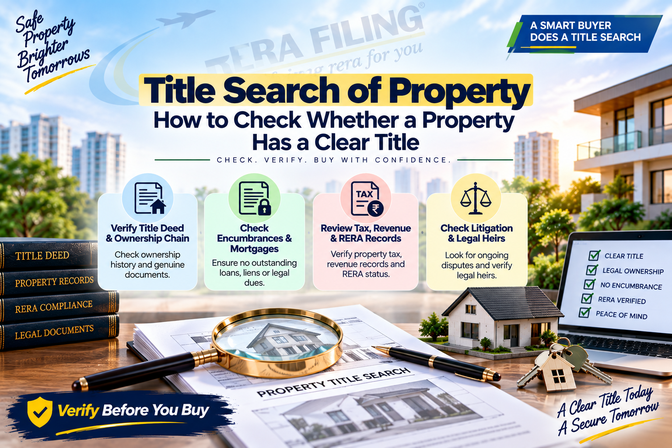
Learn how to verify a property's legal title before buying.
-
Check ownership history, encumbrances, mortgages, and litigation
-
Understand key documents like Sale Deed, EC, RERA details, and tax records.
-
Avoid costly legal disputes with proper title due diligence
Buying a property is a major financial commitment, but
before paying the token amount or signing an agreement, one of the most
important legal checks is to verify whether the seller actually has a clear
and marketable title to the property.
A property may look perfect, have all the required amenities
and even be ready for possession, but defects in ownership documents can result
in disputes, financial loss and difficulties when you later try to sell or
mortgage the property.
This is where a property title search becomes
important.
What Is a Property Title Search?
A title search is the process of examining the ownership
history and relevant legal records of a property to determine whether the
person claiming to own it has a valid and transferable interest in it.
The objective is to identify issues such as:
- Ownership
disputes
- Existing
mortgages or charges
- Previous
transfers
- Claims
by legal heirs
- Court
disputes or attachments
- Defects
in the chain of title
- Restrictions
affecting transfer
- Other
encumbrances affecting the property
A clear title generally means that the seller's ownership is
sufficiently established and the property is not affected by undisclosed claims
or defects that could prevent a lawful transfer.
Why Is Clear Property Title Important?
A buyer should not rely merely on possession of the property
or on the seller's statement that they are the owner.
A defective title can potentially result in:
Ownership Disputes
Another person, co-owner or legal heir may subsequently
claim rights over the property.
Problems in Property Registration
Defects or inconsistencies in documents may complicate the
transaction or registration process.
Difficulty Obtaining a Home Loan
Banks and financial institutions generally conduct legal due
diligence before accepting property as security.
Difficulty Selling the Property
Title defects discovered later can make the property
difficult to resell.
Litigation and Financial Loss
A buyer may have to spend considerable time and money
resolving ownership disputes.
For these reasons, title verification should ideally be
completed before making a substantial payment toward the property.
How to Check Whether a Property Has a Clear Title
1. Verify the Current Title Deed
Start by examining the document through which the current
owner acquired the property.
Depending on the transaction, this could include a:
- Sale
Deed
- Conveyance
Deed
- Gift
Deed
- Partition
Deed
- Relinquishment/Release
Deed
- Will
and succession-related documents
- Allotment
or conveyance documents from the competent authority
Check whether the document is duly executed and, wherever
registration is legally required, properly registered.
The owner's name and property description should correspond
with the property being offered for sale.
2. Check the Chain of Ownership
Checking only the latest Sale Deed may not be sufficient.
The buyer should examine the chain of title to
understand how ownership moved from one person to another over the relevant
period.
Each transaction should logically connect with the next.
For example:
Original Owner → Buyer A → Buyer B → Present Seller
If an important link in this chain is missing or unclear,
further investigation may be necessary.
3. Check for Encumbrances
An encumbrance is a legal or financial claim affecting a
property.
Examples may include:
- Mortgage
- Charge
- Existing
loan
- Attachment
- Certain
court-related restrictions
- Other
registered interests affecting the property
An Encumbrance Certificate (EC) or
equivalent property/registration records available in the relevant State can
help identify certain registered transactions affecting the property.
However, an EC should generally form one part of a
broader title investigation rather than being treated as conclusive
proof that no issue exists.
4. Verify Whether the Property Is Mortgaged
A seller may have taken a loan against the property.
If the property is mortgaged, understand:
- Which
lender holds the security
- Outstanding
loan position
- Whether
original title documents are deposited with the lender
- How
the mortgage will be released before or simultaneously with the sale
- Whether
an appropriate lender NOC/release document is required
Do not assume that a property is debt-free merely because
the seller possesses some property documents.
5. Check Revenue / Municipal Records
Depending on the nature and location of the property, review
applicable records such as:
- Mutation
records
- Property
tax records
- Municipal
records
- Revenue
records
- Khata
or equivalent records
- Land
records
These records can provide useful supporting information
regarding possession, assessment and recorded ownership.
However, mutation or payment of property tax by
itself is generally not a substitute for a valid title document.
6. Verify Property Tax and Other Dues
Ask for recent property tax receipts and check whether any
dues remain unpaid.
Depending on the property, buyers may also need to examine:
- Maintenance
dues
- Development
authority dues
- Society/RWA
dues
- Electricity/water
dues
- Lease
rent or ground rent
- Other
statutory dues
Outstanding liabilities should be identified and addressed
before completion of the transaction.
7. Check Approved Plans and Property Description
Ensure that the property described in the title documents
corresponds with the actual property.
Verify relevant details such as:
- Plot/flat
number
- Area
- Floor
- Boundaries
- Survey/Khasra
number, where applicable
- Project
name
- Parking
rights, where documented
- Undivided
share in land, where applicable
Material discrepancies should be clarified before purchase.
8. Check RERA Registration for Applicable Projects
If you are purchasing property in a project required to be
registered under RERA, verify the project on the website of the concerned State
RERA Authority.
Check information such as:
- Project
registration status
- Promoter
details
- Registered
completion timeline
- Approved
project information
- Disclosures
made by the promoter
- Project
updates
- Orders
or other information made available by the Authority
Remember that RERA registration is an important
compliance check, but it should not replace independent legal title due
diligence.
9. Check for Litigation and Disputes
A buyer should investigate whether the property or its owner
is involved in litigation that may affect the proposed purchase.
Depending upon the transaction, searches may include
relevant:
- Court
records
- RERA
proceedings
- Revenue
proceedings
- Authority
records
- Public
notices
- Other
appropriate databases
For higher-value transactions, professional legal due
diligence is particularly advisable.
10. Check Whether All Legal Heirs Have Rights
Extra caution is required when the seller acquired the
property through inheritance.
Relevant documents may include:
- Death
certificate
- Will,
if any
- Probate
or letters of administration, where applicable
- Succession-related
documents
- Family
settlement
- Relinquishment/release
deeds
- Documents
establishing the rights of legal heirs
The objective is to ensure that the person selling the
property has the legal authority to transfer the required interest.
11. Verify Power of Attorney Transactions Carefully
If the transaction involves a person acting through a Power
of Attorney (POA), verify:
- Identity
of the principal and attorney
- Scope
of authority granted
- Validity
of the POA
- Registration/authentication
requirements, as applicable
- Whether
the POA is still operative
- Whether
the attorney is specifically authorised to execute the proposed
transaction
A Power of Attorney generally authorises someone to act on
behalf of another person; it should not automatically be treated as a
title document transferring ownership.
12. Obtain a Professional Title Search Report
For a significant property transaction, buyers should
consider obtaining a title search or legal due-diligence report from a
qualified property lawyer.
A professional review can examine:
✓ Ownership documents
✓ Chain of title
✓ Encumbrances
✓ Mortgages and charges
✓ Relevant approvals
✓ Litigation concerns
✓ Seller's authority to transfer
✓ Property description
✓ Other transaction-specific risks
The scope of the title search should depend on the nature of
the property, location and transaction history.
Documents to Check Before Buying a Property
Keep this basic checklist handy:
✓ Current Sale/Title Deed
✓ Previous title documents / chain documents
✓ Encumbrance-related records
✓ Property tax receipts
✓ Mutation/revenue/municipal records, where relevant
✓ Approved plans and approvals, as applicable
✓ Completion/Occupancy Certificate, where applicable
✓ RERA project details, where applicable
✓ Loan closure / lender documents, if mortgaged
✓ Society/RWA/authority documents, where applicable
✓ Seller's identity and authority documents
✓ Inheritance documents, where applicable
✓ Power of Attorney, where applicable
Red Flags Buyers Should Never Ignore
Be cautious if:
 Original
title documents are unavailable without a satisfactory explanation.
Original
title documents are unavailable without a satisfactory explanation.
The seller's
name differs across important records.
There is a
missing link in the ownership chain.
 The seller
refuses to disclose existing loans or mortgages.
The seller
refuses to disclose existing loans or mortgages.
 Property
details differ across documents.
Property
details differ across documents.
Multiple
family members or co-owners claim an interest in the property.
There is
ongoing litigation relating to ownership.
 The seller
is pushing for a large payment before document verification.
The seller
is pushing for a large payment before document verification.
 Required
approvals or certificates cannot be produced.
Required
approvals or certificates cannot be produced.
 A project
that requires RERA registration cannot be found on the applicable RERA portal.
A project
that requires RERA registration cannot be found on the applicable RERA portal.
Is an Encumbrance Certificate Enough to Prove Clear Title?
Not necessarily.
An Encumbrance Certificate can be an important part of
property due diligence, but buyers should not rely on it alone.
A proper title investigation may require examination of the
ownership chain, registered documents, mortgages, inheritance issues,
litigation, approvals and other records depending on the property.
Clear Title vs Marketable Title
These terms are often used together in property
transactions.
A clear title generally indicates that
there are no apparent defects or competing claims affecting the owner's right
to transfer the property.
A marketable title generally refers to a
title that is sufficiently free from reasonable doubt so that a prudent buyer
can accept it and the property can ordinarily be transferred without material
legal uncertainty.
The assessment depends on the documents and circumstances of
each property.
Frequently Asked Questions
How do I know whether a property has a clear title?
Review the title deed, chain of ownership, applicable
registration and revenue records, encumbrances, mortgages, litigation,
approvals and the seller's authority to transfer the property. Professional
legal verification is advisable before completing a significant transaction.
How many years of property title should be checked?
There is no single period that is appropriate for every
property transaction. The required search period depends on factors including
the property's history, nature of title, applicable limitation principles and
available records. A property lawyer should determine the appropriate scope for
the particular transaction.
Can I buy a property if it has an existing home loan?
A mortgaged property can potentially be purchased, but the
lender's interest must be properly dealt with as part of the transaction. The
payment and release mechanism should be documented carefully.
Does mutation prove ownership?
Mutation is an important revenue or municipal record but, by
itself, should generally not be treated as conclusive proof of ownership.
Is RERA registration proof of clear title?
No. RERA registration is an important regulatory check for
applicable real estate projects, but buyers should still carry out independent
legal due diligence before purchasing property.
Should I conduct a title search before paying token money?
Ideally, key legal and ownership checks should be undertaken
before making a substantial non-refundable payment. If token money is paid
before completion of due diligence, the written terms should clearly address
what happens if material legal defects are subsequently discovered.
Final Takeaway
A beautiful property is not necessarily a legally safe
property.
Before buying a flat, plot, house or commercial property,
verify who owns it, how they acquired it, whether they have the right
to sell it and whether any third-party claim, mortgage or dispute affects it.
A proper title search before purchase can help identify
legal risks before they turn into expensive disputes.
Buying a Property? Verify Before You Buy.
Make informed decisions by checking the project's RERA
details and completing appropriate legal due diligence before committing
substantial funds.








Copyright © 2026 RERA Filing. All rights reserved.