RERA Act

 Maharashtra
 Karnataka
 Telangana
 Andhra Pradesh
 Delhi
Delhi
 Uttar Pradesh
 Haryana
 Gujarat
 Bihar
Bihar
- General
- Author: Riya Kapur
Highlights
-
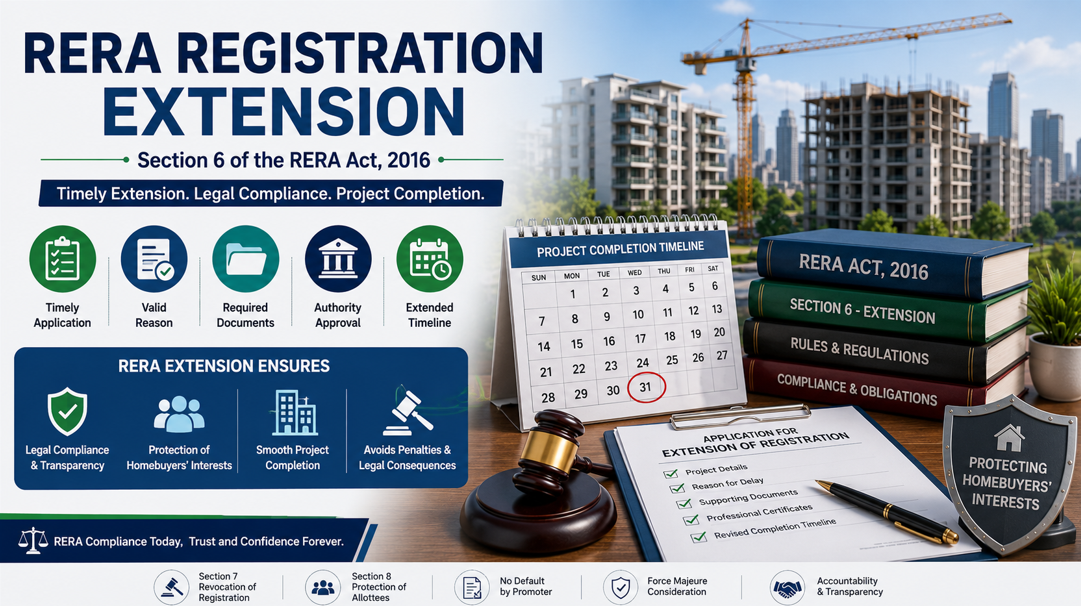
RERA registration extension is not automatic and is governed by Section 6 of the RERA Act, requiring valid grounds such as force majeure or circumstances beyond the promoter's control.
-
Promoters must submit documentary evidence, professional certifications, and a realistic completion plan to support an extension application before the registration expires.
-
Extension of project registration does not automatically extend possession timelines or eliminate buyers' rights to claim interest or compensation under Section 18 of RERA.
-
Failure to obtain a valid extension may lead to revocation of registration under Sections 7 and 8, resulting in regulatory action and measures to safeguard homebuyers' interests.
The registration of a real estate project under the Real Estate (Regulation and Development) Act, 2016 ("RERA Act") is not an indefinite regulatory approval. Every registered project has a prescribed period of registration linked to the declared timeline for completion. Where a promoter is unable to complete the project within the registered period, the legal framework provides mechanisms for seeking an extension.
However, extension of RERA registration is not an automatic right of the promoter.
The extension mechanism under RERA is governed principally by Section 6, while the consequences of expiry or revocation of registration are addressed under Sections 7 and 8. The applicable State RERA Rules, regulations, circulars and Authority orders may additionally prescribe the application form, fee, documents, professional certifications and procedural requirements.
For promoters, the critical legal question is therefore not merely whether a project is delayed, but why the project is delayed, whether the delay is attributable to the promoter, and whether the statutory and regulatory conditions for extension have been satisfied.
1. What Does Section 6 of RERA Provide?
Section 6 of the RERA Act deals specifically with extension of registration.
The central statutory provision states:
"The registration granted under section 5 may be extended by the Authority on an application made by the promoter due to force majeure, in such form and on payment of such fee as may be prescribed."
The provision further permits the Authority, in reasonable circumstances and where there is no default on the part of the promoter, to extend the registration for such period as it considers necessary, subject to the statutory aggregate limit.
The Act also provides an important procedural safeguard:
"no application for extension of registration shall be rejected unless the applicant has been given an opportunity of being heard in the matter."
Section 6 defines force majeure to include circumstances such as:
- War
- Flood
- Drought
- Fire
- Cyclone
- Earthquake
- Any other calamity caused by nature affecting the regular development of the real estate project.
2. What Are the Grounds for Extension of RERA Registration?
A generic statement that the project was delayed due to "force majeure" is unlikely to provide the same evidentiary strength as a properly documented explanation.
A. Force Majeure
This is the most expressly recognised statutory ground under Section 6.
A force majeure event must affect the regular development of the project. The mere existence of an external event is not necessarily sufficient. The promoter should be able to establish a causal connection between the event and the actual delay in project development.
For example, if a natural calamity prevents construction activity for a specific period, the promoter should ideally be able to demonstrate.
- The date on which the event occurred
- The nature of the event
- How construction activities were affected
- The duration of the disruption
- The activities that could not be undertaken
- The additional period genuinely required to complete the project.
A generic statement that the project was delayed due to "force majeure" is unlikely to provide the same evidentiary strength as a properly documented explanation.
B. Reasonable Circumstances Without Promoter Default
Section 6 also recognises circumstances where the Authority may grant an extension, based on the facts of the individual case, where there is no default on the promoter's part.
This is an important distinction.
The statutory framework does not suggest that every delay automatically qualifies for extension. The Authority is expected to examine the facts and circumstances of the individual project.
The promoter should therefore explain why the delay occurred and demonstrate that the delay was not the result of its own default or negligence.
Depending on the applicable State Rules and Authority regulations, relevant circumstances may include issues such as:
- Delays attributable to statutory authorities
- Court orders affecting construction
- Regulatory restrictions
- Land-related litigation
- Delays in essential approvals
- Natural calamities
- Government-imposed restrictions
- Other circumstances recognised by the competent Authority.
However, each case must be evaluated on its own facts.
A promoter should not assume that ordinary commercial difficulties automatically constitute force majeure
3. Force Majeure Is Not a Blanket Defence
One the most important legal principles for promoters is that force majeure cannot be invoked merely because a project is delayed.
The statutory definition under Section 6 is relatively specific. It identifies natural calamities and other events affecting regular development of the project.
This means that a promoter seeking extension should establish:
Event → Impact on Construction → Period of Disruption → Resulting Delay
The stronger the documentary connection between these four elements, the stronger the extension application.
For example, if a flood prevents access to the project site for three months, the promoter should ideally submit evidence demonstrating the occurrence of the flood, the resulting disruption and the period during which construction was actually affected.
By contrast, an unexplained multi-year delay accompanied by a general reference to "market conditions" or "financial difficulties" may face significantly greater scrutiny.
4. The Extension Application Procedure
The exact process varies from State to State, but a promoter seeking extension should generally prepare a comprehensive application containing the following information.
Step 1: Review the Existing RERA Registration
The promoter should first identify
- Original registration date
- Original completion date
- Any previous extension
- Revised completion date
- Current registration validity
- Project status
- Outstanding compliance obligations.
This is important because the Authority may examine the project's entire history rather than only the immediate extension request.
Step 2: Determine the Legal Ground
The promoter should identify whether the application is based on:
- Force majeure
- Reasonable circumstances without promoter default
- Statutory or regulatory impediments
- Court proceedings
- Government restrictions
- Other legally recognised circumstances
The ground should be clearly stated rather than using a generic explanation
Step 3: Prepare Supporting Documents
Depending on the State and the circumstances, supporting documents may include:
- Existing RERA registration certificate
- Application for extension
- Detailed explanation for delay
- Updated project progress report
- Construction photographs
- Architect's certificate
- Engineer's certificate
- CA certificate
- Updated financial statements
- Bank account details
- Litigation documents
- Government communications
- Approval-related correspondence
- Authority orders
- Revised project completion schedule
The promoter should demonstrate both the reason for past delay and the feasibility of completing the remaining work within the requested extended period.
Step 4: Pay the Applicable Fee
The extension fee is determined by the applicable State Rules or Authority regulations.
Importantly, the fee structure may differ significantly between States.
For example, the Delhi RERA Rules provide for an application for extension within the prescribed period and require the application to be accompanied by the applicable fee and an explanatory note setting out the reasons for delay and the need for extension. The Rules also distinguish force majeure applications from other extension requests in relation to fees.
Therefore, promoters should not assume that the same fee or procedure applies throughout India
Step 5: File Before Expiry
A prudent promoter should submit the extension application well before the expiry of the existing registration.
Waiting until the last moment creates avoidable regulatory risk.
The application should ideally be filed sufficiently in advance to allow the Authority to.
- Scrutinise the documents
- Raise queries
- Seek additional information
- Provide an opportunity of hearing, if required
- Pass an order before the registration expires
5. Can RERA Registration Be Extended Beyond One Year?
This question requires careful legal analysis.
Section 6 contains a statutory framework under which, in reasonable circumstances and without promoter default, the Authority may extend registration, subject to the aggregate limit specified in the Act.
However, the actual application of extension provisions can be affected by.
- The nature of the delay
- Force majeure circumstances
- State Rules
- Authority regulations
- Orders passed under Section 7(3)
- Court judgments
- Special regulatory measures
The distinction between extension under Section 6 and revival or continuation measures under Section 7(3) is therefore extremely important.
Promoters should not automatically assume that every extension request falls under exactly the same statutory route.
Recent litigation also demonstrates that the permissible scope of extension can be contentious. In a 2025 decision concerning a West Bengal project, the Real Estate Appellate Tribunal reportedly examined the extent of an extension granted by the State Authority and emphasised the statutory limits applicable to extensions under Section 6. The Tribunal ultimately restricted the extension period while also dealing with the separate issue of compensation claims.
This development reinforces the importance of distinguishing between:
Project completion delay
and
RERA registration extension
They are related, but they are not necessarily legally identical concepts.
6. Consequences of Failing to Obtain Extension
If a promoter fails to complete the project within the registered period and does not obtain a valid extension, serious regulatory consequences may follow.
Section 7 of RERA empowers the Authority to examine revocation of registration where the promoter is in contravention of the Act, Rules or Regulations, or where other statutory grounds are established.
The Authority must follow the prescribed procedure, including providing the promoter with an opportunity of being heard.
If registration is revoked, the consequences can be substantial.
The project may face:
- Regulatory restrictions
- Appointment of appropriate mechanisms for completion
- Restrictions on the promoter's ability to continue marketing or dealing with the project
- Financial consequences
- Enforcement proceedings
- Other measures contemplated under the Act
The promoter should therefore not treat an expired registration as a mere administrative lapse.
7. Section 8: What Happens After Lapse or Revocation?
Section 8 of the RERA Act deals with the obligations of the Authority following the lapse or revocation of registration.
The legislative objective is to protect the interests of allottees and ensure that the project does not simply remain abandoned because the promoter's registration has expired or been revoked.
The Authority may take measures contemplated under the Act to facilitate completion of the remaining development work.
This is particularly important from a consumer-protection perspective.
RERA is designed not merely to regulate promoters but also to ensure that homebuyers are not left without a remedy when a project becomes stalled.
8. Does RERA Registration Extension Automatically Extend the Possession Date?
This is one of the most misunderstood aspects of RERA law.
A promoter obtaining an extension of project registration does not necessarily mean that the possession date mentioned in an Agreement for Sale is automatically rewritten.
The rights of allottees under the Agreement for Sale and Section 18 of RERA must be analysed separately.
A regulatory extension may permit the project to remain registered and continue under the regulatory framework. However, whether an allottee is entitled to interest or other relief for delayed possession depends on the applicable statutory provisions, the Agreement for Sale, the facts of the case and the effect of any legally recognised force majeure period.
This distinction is especially important because an extension of registration and an extension of contractual possession obligations are not automatically interchangeable.
The Maharashtra Real Estate Appellate Tribunal has recently addressed this issue in a significant decision, reportedly rejecting a unilateral extension of the possession timeline where the extension effectively altered the contractual position without adequate legal basis or buyer consent. The Tribunal also examined whether statutory delays and infrastructure-related issues could qualify as force majeure.
The broader lesson is that promoters should never assume that obtaining a RERA registration extension automatically eliminates all potential delay-related liability to allottees
9. COVID-19 and Force Majeure Extensions
D-19 pandemic provides an important example of regulatory intervention concerning project delays.
Following the disruption caused by the pandemic and lockdowns, the Ministry of Housing and Urban Affairs advised RERA Authorities regarding measures that could be adopted in relation to force majeure and project registration timelines.
UP-RERA, for example, issued directions concerning extension of project registrations affected by the pandemic. The approach recognised the pandemic as a force majeure event affecting the regular development of real estate projects and contemplated regulatory extensions for qualifying projects.
However, promoters should be careful not to assume that every delay occurring during or after the pandemic is automatically protected.
The legal question remains:
What part of the delay was actually caused by the force majeure event?
A promoter may need to distinguish between:
- The lockdown period
- Labour disruption
- Supply-chain disruption
- Approval delays
- Financial difficulties
- Pre-existing project delays
- Post-pandemic delays
10. State-Wise Differences in RERA Extension
One of the most important practical aspects of RERA extension applications is that the process is not uniform across India.
The central Act establishes the legal framework, but State Governments and RERA Authorities prescribe detailed procedures.
Delhi RERA
The Delhi RERA Rules provide a structured application mechanism, including a prescribed form, an explanatory note setting out the reasons for delay and the need for extension, and payment of the applicable fee. The Rules also provide special treatment for force majeure applications and prescribe a procedure for communication of approval or rejection.
Uttar Pradesh RERA
UP-RERA has issued specific directions concerning project extension and has also implemented special measures during exceptional circumstances such as the COVID-19 pandemic.
Promoters in Uttar Pradesh should therefore examine the latest UP-RERA portal requirements, applicable Rules and Authority orders before filing an extension application.
Haryana RERA
Haryana's two RERA Authorities—Gurugram and Panchkula—operate within the Haryana RERA framework, but promoters must carefully examine the applicable Authority's current regulations, orders and portal procedures.
A promoter should maintain a detailed project status report and ensure that the extension application is supported by appropriate professional certifications and documentary evidence.
Maharashtra – MahaRERA
MahaRERA has developed detailed regulatory mechanisms concerning project registration, extensions, project completion and compliance.
Promoters should review the latest MahaRERA circulars, regulations and orders because extension applications can involve project-specific disclosures, professional certifications and compliance conditions.
The recent MREAT decision concerning unilateral alteration of possession timelines also highlights the importance of carefully separating regulatory project extension from contractual possession obligations.
11. Common Reasons for Rejection or Regulatory Scrutiny
An extension application may face difficulty where
1. The promoter provides no credible reason for delay
A vague explanation is generally weaker than a documented factual explanation
2. The delay is attributable to the promoter
Financial mismanagement, lack of funds, poor planning or internal management problems may not automatically qualify as force majeure
3. The application is filed too late
Late filing can create complications, especially where the existing registration has already expired
4. Previous extensions have not resulted in meaningful progressThe Authority may examine whether the promoter has actually progressed toward completion
5. Project compliance is pending
Outstanding quarterly updates, financial disclosures or other statutory compliances may affect the Authority's assessment
6. The requested extension period is unsupported
The promoter should explain why the exact additional period requested is necessary.
7. The project remains financially unviable
Where the promoter cannot demonstrate a credible completion plan, the Authority may scrutinise the extension request more closely.
12. Recommended Documents for a Strong Extension Application
A professionally prepared extension application should ideally include:
Legal Documents
- Existing RERA registration certificate
- Previous extension orders
- Title and land documents, where relevant
- Court or litigation orders.
Project Documents
- Updated project status
- Construction progress
- Revised completion schedule
- Photographs
- Remaining work statement
- Architect's certificate
- Engineer's certificate
- CA certificate
- Financial progress statement
Delay Evidence
- Government notices
- Approval correspondence
- Court orders
- Natural calamity evidence
- Labour or construction disruption records
- Authority communications
Financial Documents
- Project bank statements
- Separate account details
- Project expenditure statement
- Funds available for completion
- Estimated cost of remaining work
The strongest application is one that allows the Authority to answer three questions:
Why was the project delayed?
Was the delay beyond the promoter's control?
Can the promoter realistically complete the project within the requested extension period?
13. Legal Compliance Checklist for Promoters
Before filing
an extension application, promoters should verify: Current RERA registration validity Original completion date Previous extension history Actual project progress Reason for delay Whether the delay qualifies as force majeure Evidence supporting the delay Pending regulatory compliances Project financial position Remaining construction cost Revised completion timeline Professional certificates Applicable extension fee State-specific application form Latest RERA circulars and Authority orders Potential impact on allottee rights
Conclusion
Extension of
RERA registration is a significant regulatory process that should never be
treated as a routine formality.
Section 6 creates a statutory mechanism for extending registration in cases involving force majeure and, subject to the statutory conditions, reasonable circumstances where the promoter is not in default. At the same time, the Act preserves a regulatory framework designed to protect allottees and prevent indefinite project delays.
The most important legal distinction is between extension of RERA registration and extension of contractual possession obligations. Obtaining an extension from a RERA Authority does not, by itself, automatically resolve every question relating to delay compensation, interest or an allottee's rights under Section 18.
Promoters should therefore approach extension applications strategically and transparently.
A successful application should be supported by:
A legally sustainable ground + documentary evidence + professional certifications + financial transparency + a realistic completion plan.
The practical approach for a promoter is to initiate the extension process well before the registration expiry date, conduct a complete review of all pending RERA compliances, identify the precise legal basis for the extension, and prepare a state-specific application in accordance with the latest Rules, Regulations, Circulars and Authority directions.
For promoters operating across multiple States, professional RERA advisory is particularly important because the central statutory framework is uniform, but the practical extension procedure, fees, forms, documentation and regulatory conditions can differ significantly between jurisdictions.
Ultimately, RERA registration extension should be viewed not simply as a mechanism to "buy more time", but as a formal regulatory process requiring the promoter to demonstrate accountability, genuine cause for delay and a credible pathway toward project completion.
Disclaimer: This article is intended for general legal and regulatory information and does not constitute legal advice. RERA Rules, Regulations, circulars and Authority orders may be amended from time to time. Promoters and allottees should verify the latest applicable legal and regulatory requirements before taking action.









Copyright © 2026 RERA Filing. All rights reserved.